


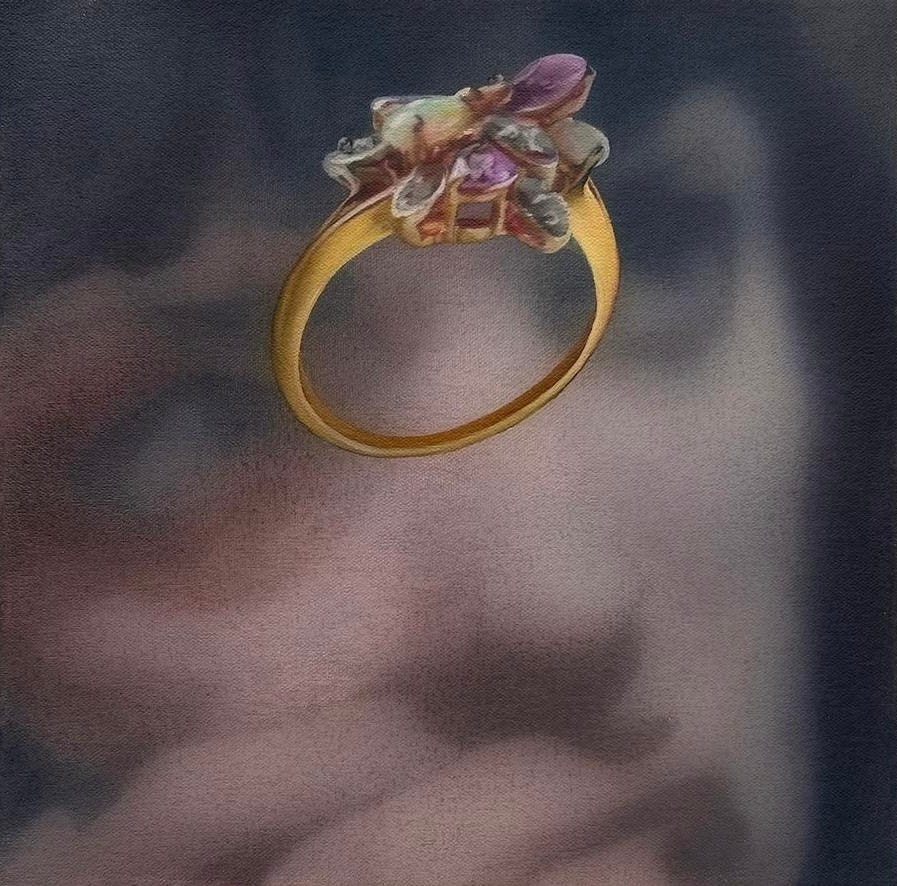
Your paintings feel like dreams that you half remember. They're ghostly and tender, and feel just out of reach from the viewer. As you're creating your work, how do you know when an image belongs in this world that you've created, whether it's like in the overall world of your work or just in that specific piece? What draws you to that blurry place that feels both real and not?
I was recently rereading Just Kids by Patti Smith and there was a paragraph where Patti was writing about how Robert Mapplethorpe was using the word magic, and he would use it to describe a successful poem or drawing, or a photo he would choose from a contact sheet. She wrote that he would say, this is the one with magic. And when I read that in the book, it just instantly resonated with me. That's exactly how I feel when both choosing my imagery that I'm working with and just the painting itself. I think that's why I work in series with a lot of similar composition and subject matter. It's so I can have more chances to get the one with the magic.
That's amazing. I love that. I love that through each series, we're exploring with you and trying to find that magic within the work. I also love that it was inspired by Just Kids. It's an incredible book. It's one that I also return to often whenever I need to feel inspired to create again.
There's this deep sense of longing in your work, like the figures are reaching for something that they can't quite grasp. Is this an intentional energy that you create in your work? What does this desire to reach something mean to you in your practice? Is it emotional, personal, or spiritual?
I like that you used the word desire. Desire is exactly the point, and it can manifest in so many different ways. Recently, I've been trying to capture the desire for, it's hard to describe but Germans use a word called ‘senhsucht.’ It has a meaning similar to longing and a desire for something, but it's more along the lines of an intangible longing. It doesn't really have a clear object, but it still insists on reaching for something you can't quite grasp. You don't know exactly what it is you're reaching for.
I've been thinking about this a lot because I feel like in today's world with technology, I feel like we're not as close with each other. Community wise, there's this void opening up. I feel like this absence is kind of making people, you know, long for that intent. I've been interested in this absence and what the absence drives us to do. And recently, my research has resulted in a lot of cultishness and fanaticism. I think it is that desire for something more that draws people into groups like these and that type of mindset.The search for something to fill the void and provide meaning can manifest in believing or wanting so deeply to believe and prove things like UFOs, aliens, Bigfoot, just to be part of something bigger.
I agree with your point that technology kind of made the world feel smaller, because you do have access to people from all over the world that you wouldn't necessarily have had access to before the advancement of technology, but it has also made us really comfortable in being so separate from one another. And I do feel like so many of us are reaching and longing for more human connection on a deeper level, other than a surface connection via social media.
I don't think we realize how isolated we actually are because of social media too. It seems like it is so connected but I feel like a lot of us don't even know how to access a community, so a lot of people turn to strange beliefs to feel like you're a member of something.
It reminds me of a lot of the cults in the 60s and the 70s where people, especially young people, felt very alienated from their parents because there was such a drastic shift in morals and from the way their parents lived and the way they wanted to live. They wanted to seek out like-minded individuals and spaces in which they felt seen and heard and needed as well. I feel that's why so many people ended up making poor decisions as to who they surrounded themselves with.
It's all about wanting to be part of something important and something bigger. I watched a documentary on the Heavens Gate cult, and it really got you inside their minds. I could see myself feeling the same way. If you're in the middle of your life, nothing really to show for it, but you feel like there is something special still. Why not believe in UFOs and that they're gonna come down and get you? If it brings you comfort, why not?
I find the psychology behind them fascinating. You've said that your work lives between the archive and the altar, particularly in new work, which is why I find such a beautiful way to describe your work. Can you talk about what that specific space means to you? How do memory, imagery and honor come together in the process of creating that space?
I like to work with imagery that already exists. I like the fact that it's already in the collective consciousness. I source a lot of my imagery from places like internetarchive.com and antique stores. I like to get old found photos of anonymous individuals. A lot of my work from last year is based on found photos from antique stores and Ebay. I also use a lot of imagery from film stills. I'm working on a piece right now using old concert footage that was just re-uploaded to YouTube. I also find things on conspiratorial blogs and things like that. And when I find the one with magic, I like to crop and distort them and kind of decontextualize them to imbue a new context. Through the act of painting it and taking that time to create a new image, I feel like there becomes something sacred about it.
Your work has this quiet power, almost like it's pulling from something sacred. What's your relationship to secularism, and how does that show up in the rituals or the symbols that you choose to create?
I’m of Italian and Irish descent, so I was raised Roman Catholic. My parents aren't necessarily religious, but I was sent to Bible school and had my Holy Communion pretty much just to appease my grandmothers, who were deeply, deeply religious, but I started to kind of rebel against the church. I was sent to classes for confirmation and I guess I caused a big enough problem for my parents to make me go anymore. But I've become more interested in the devotional aspects, especially because I think people choose religion because of that desire for meaning, guidance, or sense of belonging. That longing for something more. In my work I want to observe the reason for it in a way that’s hard to explain. It’s that devotional aspect that I'm interested in, and making comparisons with secular society.
The question I always come back to with religion is, what are you hoping to get out of it?
I'm curious how your identity shapes what you create, whether that's cultural, emotional, or even just how you move through the world. Do you ever feel like your sense of self is something that shows up in your images even if it's not always visible?
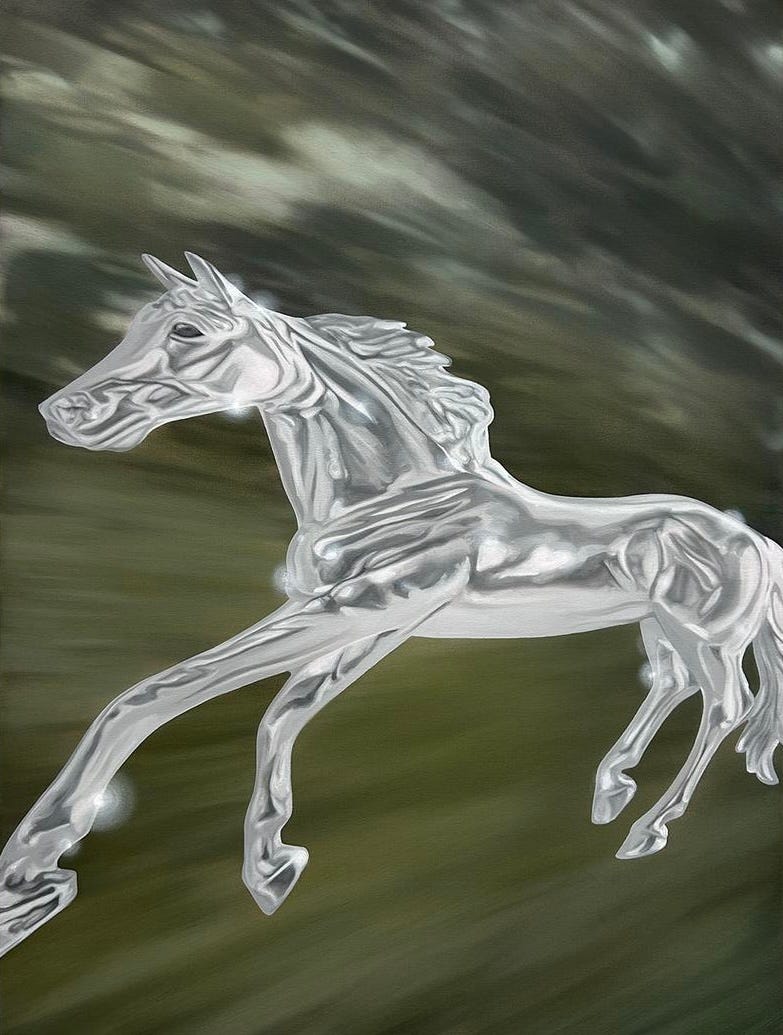
I don't actively consider myself when creating my work, but I do think that you can see reflections of the self in any artist's work. I did grow up with religious influences so references to its imagery are prevalent in my work. Certain pieces, like Escape (2025), the one with the big chrome horse, do have a reflection of me. That one is based on a childhood memory of being in the back seat of my parents car, looking out the window and imagining a horse running up beside the window so I could jump out, get on the horse and ride away. I would always have that image in my head when I was a little kid. It's not obvious that that's my childhood imagination in a painting, but it is. I also have a personal relationship to the beanie babies and the altar painting. So there's some aspects of the work that can pinpoint my identity, but I'm not consciously thinking about it when I'm making my work or coming up with new ideas.
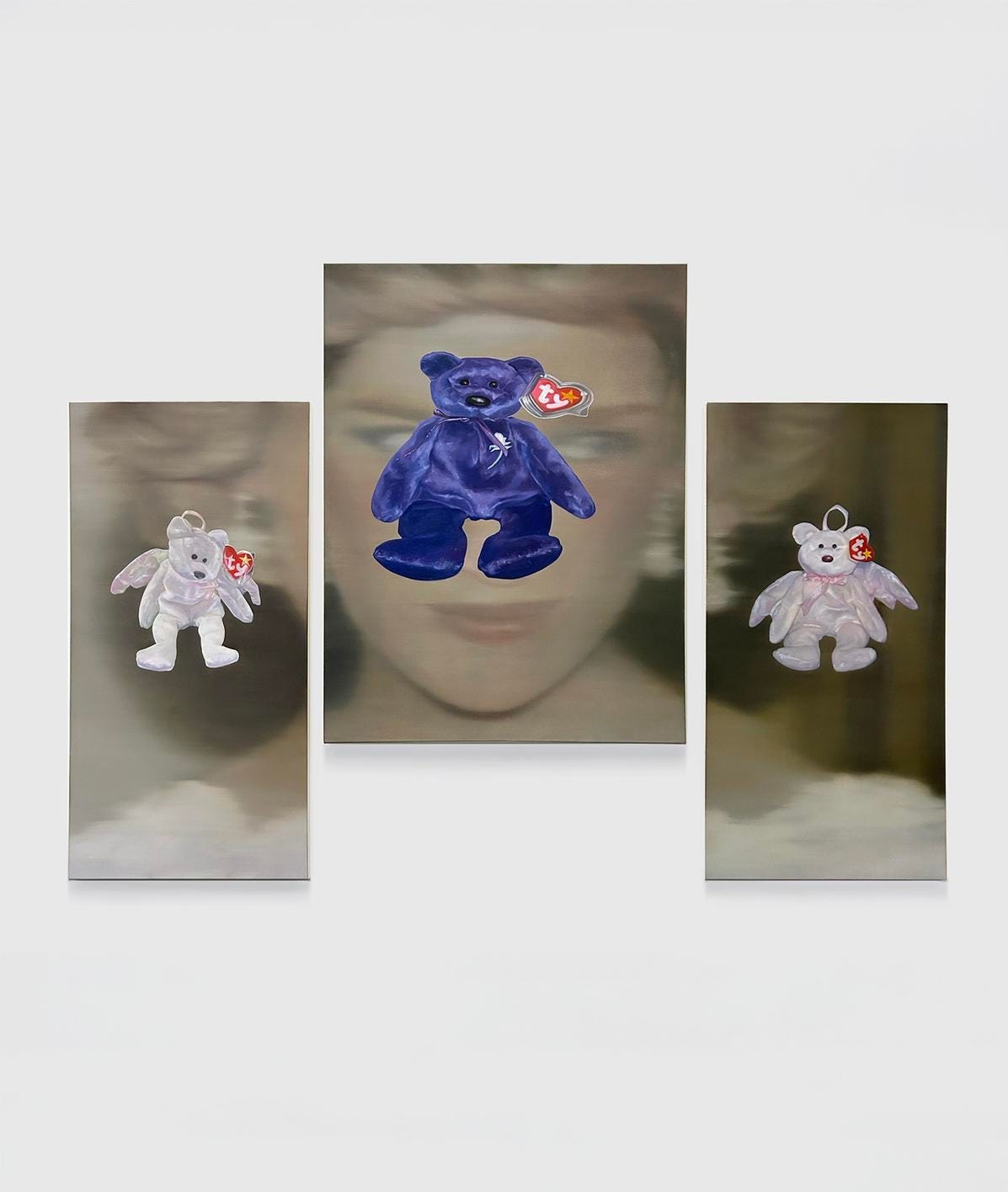
I love those pieces. I love the layering of symbolism in them. Seeing the Beanie Babies brings me back to like being a kid. I remember playing with and collecting them. Also, the meaning that the Beanie Babies hold for people, which is so special, but if you look at the piece further, what are the other meanings? What is the relationship with the Beanie Baby to the other objects around it, or the image that's lying just underneath it? That's one of the things that really pulled me to your work, was this layering of symbolism because I'm always interested in work that makes me question what is lying below the surface. With your work, there's what you can very clearly see, and then the blur of what's underneath.
So with the Princess Diana piece, I was thinking about how religious aspects can show themselves in secular society. I was thinking about a secular saint, and who better than the people's princess, Princess Diana? I was also thinking about relics in that sense, and thought the Beanie Baby commemorating her death would be the perfect subject to use. But it also goes into the Beanie Baby craze itself and the worship of them and how people turn to them as this source of hope that maybe one day they'd be worth their kids college tuition or something like that. It's also about the commodification of death through this mass produced toy. This is the Beanie Baby and is the most sought after one. Have you heard of a Labubu?
Yeah, I hadn't for a while. But now they're all over the place, I feel like that's like a new type of Beanie Baby.
Now with the blind box ones there's this added level of gambling to it, which furthers the point with of hoping for something special from this toy, which I think is so interesting,
For me personally, it just calls into question what we as a society are willing to spend money on? It can act as a signifier of your disposable income or your wealth. I also like that you brought up that the Princess Diana Beanie Baby is a commodification of death. Sometimes it feels like we as a society are kind of desensitized to the idea of death, so much so that we're purchasing things that are references to death. It's really interesting that it's a symbol in your work, particularly since you're looking at these sources that deal with religion or with cults.
Last question, what keeps you coming back to painting? In a world that's constantly moving, especially with how quickly everything moves with social media and how short our attention spans seem to be, your work feels like a pause. It feels like a moment for us to kind of take a step back and settle back into ourselves, and a moment to sit with mystery and with longing. What's the deeper pull behind what you make?
Sometimes, making art does feel a little ridiculous, especially in today's world. I've talked with a lot of my artist friends about this, and they feel the same way a lot of the time, but the consensus is usually that there's nothing else really to do. And I think art is useful in times of crisis. Just that act of creation. It's important to understand what desire can drive us to do and believe, but I think painting is how I reflect the times and it’s recurrently evident that the themes that I'm working with are alive and well around us.
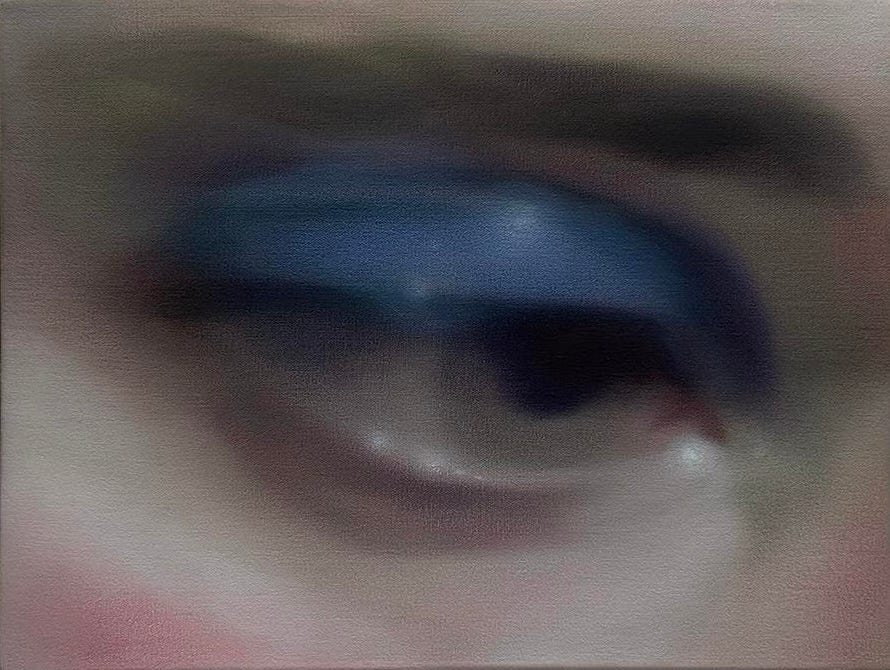
I think with a lot of things, we can bring up that question of, why? Why do anything? Why do we do what it is that we do? But I think with art, particularly, there is this societal habit to devalue art as frivolous. That there's really no value in doing it. But the thing is, art is all around us, and without art, we would be so incredibly bored and devoid of understanding of our emotions. As you said, art does help us better understand our place in the world.
Absolutely. I couldn’t have it said better myself.
In Nicolina’s world, longing is its own language. Sound familiar? We’re feeling it too. See you in Ghosted this weekend.